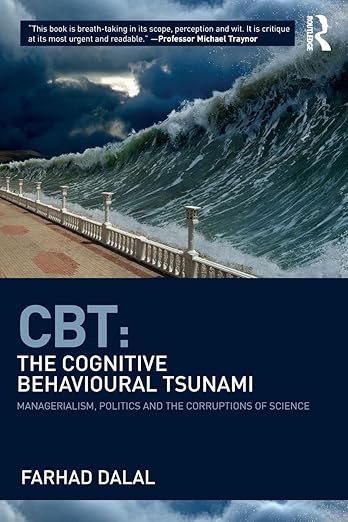
CBT : the cognitive behavioural tsunami : managerialism, politics and the corruptions of science

By Farhad Dalal

CBT: The Cognitive Behavioural Tsunami is a groundbreaking critique that exposes how political and economic forces have corrupted mental health science, transforming evidence-based practice into a commodity-driven industry that often fails those who need help most.

$29.00

About the Book

This courageous and meticulously researched book reveals how neoliberal policies, biased research, and managerial agendas have converged to create a mental health system that prioritizes efficiency and profit over genuine healing. Dalal demonstrates how CBT became the dominant therapeutic approach not through superior clinical outcomes, but through political maneuvering and economic incentives.

Drawing on extensive analysis of research methodologies, policy documents, and clinical realities, the book exposes the systematic corruption of scientific evidence. It shows how randomized controlled trials were misused to justify the mass rollout of brief CBT interventions, despite limited evidence of effectiveness for severe mental illness and questions about long-term outcomes.

Essential reading for therapists, researchers, policymakers, and anyone concerned about the commodification of human suffering, this book serves as both a wake-up call and a call to action. It challenges us to reclaim authentic, relationship-based psychotherapy and resist the reduction of mental health care to standardized protocols driven by corporate interests rather than patient needs.

Customer reviews

Read what others are saying about CBT: The Cognitive Behavioural Tsunami.

Dahlstrom Reviewed in the United States on May 3, 2019

Verified Purchase

This is an important book that offers a thoughtful and comprehensive review of the sad state of mental health research. We need more people questioning the status quo of CBT. The pages in this book allow one the ammunition to advocate for more robust and clinically meaningful mental health research.

10 people found this helpful

mariano fernandez Reviewed in the United States on November 11, 2024

Format: Paperback Verified Purchase

Libro ameno y profundo que aporta reflexiones cruciales sobre la medicalización abusiva de la vida humana y sobre los peligros de la hiperacionalización de la salud mental.

One person found this helpful

William Sharp Reviewed in the United States on July 17, 2019

Format: Paperback Verified Purchase

Every therapist needs to read this book. A real analysis of the research and how capitalism is driving the industry for capital gains and not mental wellness.

13 people found this helpful

Meadow C Reviewed in the United States on December 8, 2020

Verified Purchase

Required reading for a graduate psychology course. Excellent book. Well written. Easy to understand.

3 people found this helpful

Janice Muhr, Ph.D. Reviewed in the United States on March 4, 2019

Format: Paperback Verified Purchase

Dalal carefully and articulately lays out the perfect storm of neoliberal policies appropriating biased research findings to transform the British system into one where few people find any real treatment for emotional suffering. We in the U.S. need to take note--we're heading in the same direction.

11 people found this helpful

Chris Coggon Reviewed in the United States on December 11, 2019

Format: Paperback Verified Purchase

Thanks! Exactly as listed. Fast Canadian shipping, good packing. 5 stars.

One person found this helpful

Nancy Burke Reviewed in the United States on March 3, 2019

Format: Paperback

This book is essential reading for anyone concerned about the commodification of human suffering. Dalal dives deep to show how a perfect storm of political and social forces has yielded an anti-psychology psychology. Let this be a cautionary tale to US mental health services.

9 people found this helpful

JTA Reviewed in Canada on May 3, 2019

Format: Paperback Verified Purchase

Excellent text, refreshingly honest perspective

Dr. Hamid Peseschkian Reviewed in Germany on February 22, 2020

Format: Paperback Verified Purchase

A very important book, an eye opener to understand why psychotherapy suddenly became so CBT oriented, and what has happened to our rich humanistic and psychodynamic heritage

2 people found this helpful

jds Reviewed in the United Kingdom on January 13, 2024

Format: Paperback Verified Purchase

This is an excellent book by a UK psychodynamic psychotherapist. The biggest problem with CBT, from my perspective of having worked in the NHS since 1995 (not as a psychodynamic psychotherapist), is that CBT doesn't work for people with severe and enduring psychiatric illnesses ('real patients'), at all. This is contrary to received wisdom from the CBT faithful, the academics who promote CBT and carefully avoid real patients, and who use (as the book explains so clearly) what appears superficially to be the scientific method to justify their CBT product.

The bad news is that in the real world, no psychotherapy including CBT 'works' better than placebo, and medication works well for a few patients ('service users' is the official NICE term in the UK) but not well, or not at all, for most NHS 'service users'.

At least with medications safety and efficacy clinical trials came first, before the medications were introduced into routine NHS use with patients. In contrast, all psychotherapies including CBT were introduced first and clinical trials done later to try and justify their increased use, promoted by partisan academics with personal career 'success' as their goal. With medications in the UK, there is a robust surveillance system for adverse effects, and people have to be trainned, qualified, and registered, to prescribe (doctors). In contrast, there is no surveillance system for psychotherapy harms (which exist), and there are no mandatory trainning, qualifications, and registration, for "therapists" to work in the UK. As the book describes, the requisite clinical trial design to reduce bias (concluding a treatment is effective when its not) is the double blind randomised placebo-controlled trial, yet this is impossible in CBT and with all other psychotherapies. This means unbiased evidence for CBT efficacy is just not there which the book explains well.

The current UK system denies or just ignores all the above, meaning real problems can not even be acknowledged, which is a pre-requisite for progress and better treatments. This results in the current 'faith based' system of NHS 'treatments', masquerading as evidence-based medicine and clinical psychology, which comprises NHS 'mental health'. The book provides an excellent overview.

Limitations of the book are that it doesn't discriminate 'real patients' from the worried well (the former have an average reduction in life expectancy in the UK of 15 to 20 years, with only 5% deaths due to suicide, according to official UK government figures - the latter don't), and gets a few aspects of science and medicine a bit wrong. However, the vast majority of the book is entirely accurate and very clear and I hope the book is widely read.

3 people found this helpful

CBT : the cognitive behavioural tsunami : managerialism, politics and the corruptions of science $29.00